Solar Net Metering Pakistan 2026: New WAPDA Rates & Rules Explained ⚡
Solar Net Metering Pakistan 2026 is the biggest change in Pakistan’s energy policy this year. The government has reduced the WAPDA buyback rate from Rs. 27 to Rs. 21 per unit. This single change has ended the era of earning money from solar. Now, the purpose of installing solar is to reduce your electricity bill to zero and gain energy independence.
Despite the lower buyback rate, 2026 is still the best year to install solar. The reason is simple: the solar panel price 2026 has dropped by almost 20%. Due to cheaper imports from China and a stable US dollar, the overall system cost has come down significantly. This price reduction balances the lower export rate and keeps the Return on Investment, or ROI, at around 2.5 to 3 years.
Electricity tariffs in Pakistan have now crossed Rs. 58 to Rs. 72 per unit for domestic users. Combined with frequent load shedding, households and businesses are under huge financial pressure. This is why Solar Net Metering Pakistan 2026 is becoming a necessity, not a luxury. In this guide, we will cover everything from the net metering cost pakistan 2026 to the wapda green meter 2026 process, documents, subsidies, and expert tips to maximize your savings.
What is Solar Net Metering Pakistan 2026? New Rules Explained
Net metering allows you to connect your solar system to the national grid. You use solar power during the day, and any extra electricity is exported to WAPDA. At night or during cloudy weather, you import electricity from the grid. The meter only records the difference, which is why it is called ‘net’ metering.
The biggest change in Solar Net Metering Pakistan 2026 is the shift from Gross Metering to Net Billing. Under the old gross metering system, you were paid for every unit you exported, regardless of how much you consumed. Under the new net billing system, WAPDA subtracts your exported units from your imported units and bills you only for the difference.
Another major update is the Power Purchase Agreement, or PPA. The PPA term has been reduced from 25 years to 10 years. After 10 years, the government will revise the buyback rate again. This means you should view solar as a long-term bill-saving tool, not a short-term income source.
Solar Net Metering 2026 Quick Facts & Data Table
| Detail | 2026 Update |
|---|---|
| WAPDA Buy Rate | Rs. 21 Per Unit |
| Consumer Sell Rate | Rs. 58 to 72 Per Unit |
| Wapda Green Meter 2026 Cost | Rs. 60,000 Total |
| Approval Duration | 20 to 30 Days |
| PPA Agreement Term | 10 Years |
| Expected ROI | 2.5 to 3 Years |
| System Lifespan | 25 Years |
As you can see, the net metering cost pakistan 2026 now includes a Rs. 60,000 fee for the green meter and WAPDA application. This is Rs. 20,000 more than in 2025. However, the 20% drop in the solar panel price 2026 offsets this increase, making the total investment almost the same as last year.
1KW to 10KW Solar Cost Pakistan 2026 – Full Price Breakdown
The solar panel price 2026 has become the main driver of affordability. The introduction of N-Type TOPCon panels has made solar more efficient and cheaper. N-Type panels perform 5% better than old P-Type panels, especially in Pakistan’s high-temperature climate.
Let’s look at the updated prices. The 1kw solar cost 2026 is now between Rs. 1,60,000 and Rs. 1,90,000. A 1KW system generates around 120 units per month. At Rs. 58 per unit, this saves you Rs. 6,960 every month, or Rs. 83,520 per year.
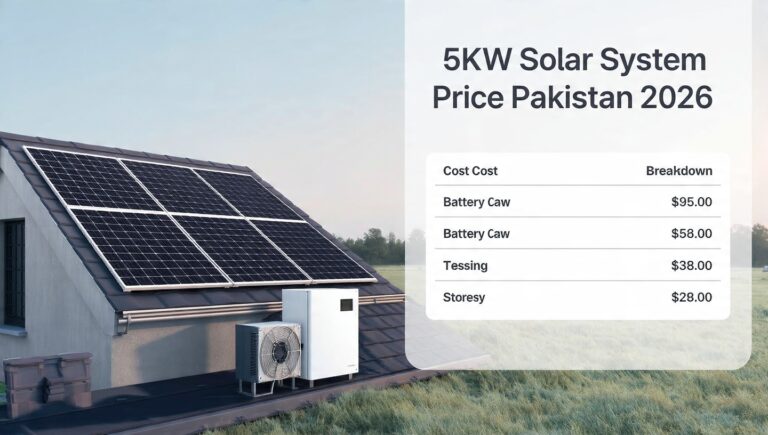
A 3KW system for your home costs between Rs. 4,40,000 and Rs. 5,20,000. It produces 360 units monthly, saving Rs. 20,880 per month. The 5KW system is the most popular choice in Solar Net Metering Pakistan 2026. It costs Rs. 6,80,000 to Rs. 8,00,000 and produces 600 units, eliminating a bill of Rs. 34,800.
For large homes or commercial use, a 10KW system is ideal. The cost is Rs. 12,80,000 to Rs. 15,20,000. It generates 1200 units per month and saves Rs. 69,600. Please note that all these prices include panels, a hybrid inverter, wiring, structure, and labor. The wapda green meter 2026 cost of Rs. 60,000 is charged separately.
WAPDA Green Meter 2026 Process: Step-by-Step Guide
Getting the wapda green meter 2026 is the most critical part of the process. Without it, your system will be a zero-export system, and you cannot send power back to the grid. The process is now more digital and transparent, but it still requires patience.
Step 1: Choose an NEPRA-Licensed Vendor. This is non-negotiable. You can check the official list of approved vendors on the NEPRA website. Hiring a local shop will result in rejection.
Step 2: Load Analysis. Check your last 12 months’ electricity bills. Calculate the average units. If your average is 300 units, a 3KW system is enough. If it is 500+, go for 5KW. Correct sizing is key to managing the net metering cost pakistan 2026.
Step 3: Submit Application. Visit your WAPDA sub-division. Submit the form with a Rs. 15,000 pay order, CNIC copy, property documents, and the Single Line Diagram from your vendor. Step 4: Site Inspection. A WAPDA engineer will visit within 20 days to check wire gauge, earthing, and structure strength.
Step 5: Installation & Commissioning. Once approved, the wapda green meter 2026 is installed within 10 days. The engineer will activate your system and test it. Step 6: PPA Signing. You will sign a 10-year agreement with WAPDA. After this, your system is live.
Documents Required for Solar Net Metering Pakistan 2026
To avoid rejection and delays, prepare these 7 documents before applying for the wapda green meter 2026. 1. Original CNIC of the owner + 2 photocopies. If the property is rented, you need an NOC from the owner.
2. Property registry or rent agreement. 3. Last 12 months of electricity bills. 4. Single Line Diagram, or SLD, made by your vendor. 5. Copy of the vendor’s NEPRA license. 6. Rs. 15,000 pay order in the name of WAPDA. 7. Technical specification sheet of your solar system.
If all documents are complete and correct, WAPDA approves the application in 20 days. Any missing paper can delay the process to 40 days or more.
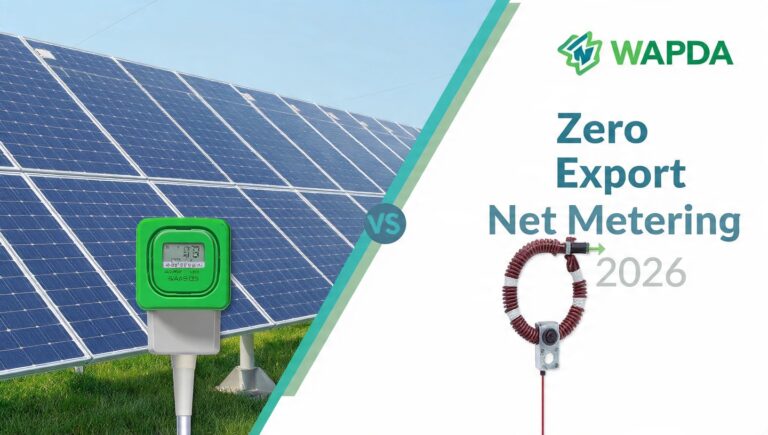
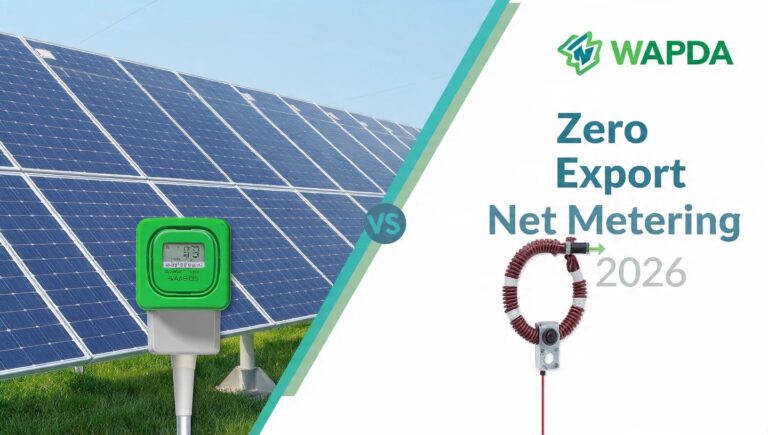
Net Metering vs Zero Export 2026: Which Should You Choose?
This is the biggest confusion in Solar Net Metering Pakistan 2026. A net metering system uses a bi-directional green meter and requires WAPDA approval. A zero-export system uses your existing meter and needs no approval.
The advantage of net metering is that you can save excess units during the day and use them at night. This makes your bill 100% zero. The disadvantage is the Rs. 60,000 cost and 30-day wait for the wapda green meter 2026.
Zero export systems are cheaper and faster to install. However, any extra solar power you produce during the day is wasted. It cannot be sent to the grid. So, if your monthly bill is less than 300 units, zero export is better. If your bill is over 500 units, Solar Net Metering Pakistan 2026 is the only smart choice.
People Also Ask: PAA for Solar Net Metering Pakistan 2026
Is Solar Net Metering Pakistan 2026 still profitable?
Yes, but only for saving money, not for earning. With the buyback rate at Rs. 21, you cannot make a profit. However, if your bill is Rs. 20,000 per month, your investment will be recovered in 2.5 years. After that, you get 22 years of free electricity. The low solar panel price 2026 makes this possible.
What is the 1kw solar cost 2026 in Lahore and Karachi?
The 1kw solar cost 2026 is Rs. 1,60,000 to Rs. 1,90,000 in both cities. Lahore is slightly cheaper due to lower transport costs. This cost is part of the total net metering cost pakistan 2026 and does not include the wapda green meter 2026 fee.
How does the wapda green meter 2026 work?
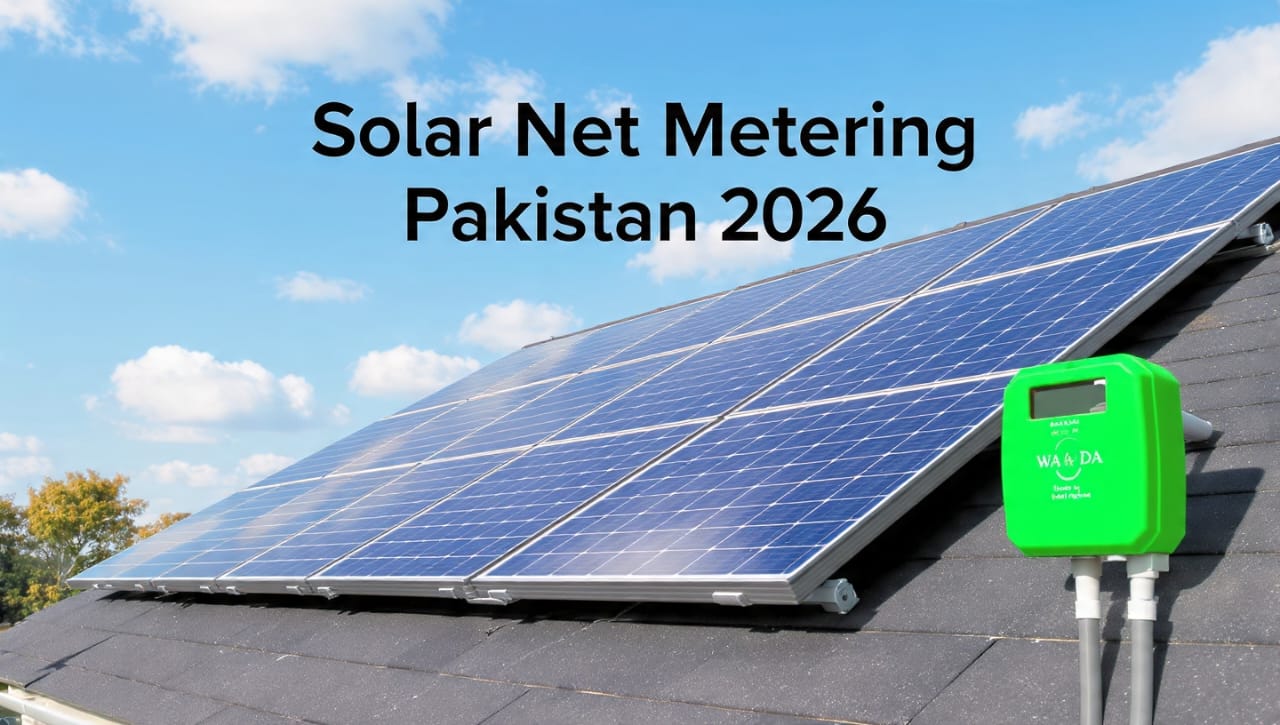
The wapda green meter 2026 is a bi-directional meter. It has two readings: one for the electricity you import from WAPDA, and one for the electricity you export. At the end of the month, WAPDA subtracts the export from the import and bills you for the net amount.
Government Subsidy, Tax Free & Bank Loans 2026
The government is supporting Solar Net Metering Pakistan 2026 through 3 main incentives. First is the Punjab Roshan Gharana Scheme. Under this, you can get a 1KW system for 50% of the cost, i.e., around Rs. 80,000. Apply at cm.punjab.gov.pk.
Second is bank financing. HBL, Meezan Bank, and Bank Alfalah are offering solar loans at 6% markup for 5 years. The down payment is only 20%. Third, solar panels and inverters have 0% customs duty and 0% sales tax. This is the main reason for the drop in the solar panel price 2026.
10 Expert Tips to Get Maximum Savings from Your Solar System
1. Run heavy loads between 10 AM and 3 PM. This is when your panels produce the most power, so it’s free. 2. Always choose N-Type panels. The solar panel price 2026 for N-Type is now almost equal to P-Type.
3. Install panels at a 22-degree angle in Lahore and 25 degrees in Karachi. This gives 12% more production. 4. Clean your panels every 15 days. Dust can reduce output by 8%. 5. Never buy an on-grid inverter. A hybrid inverter is a must for load shedding.
6. Avoid any shading. Even a small tree branch can reduce production by 20%. 7. Avoid using ACs and motors from 6 PM to 10 PM. This is the peak tariff time at Rs. 72 per unit. 8. Get a 25-year performance warranty and 12-year product warranty on panels.
9. Pay your vendor 70% after installation and 30% after the wapda green meter 2026 is installed. 10. Service your system every 6 months. Tighten wires and check connections to protect your investment.
Conclusion: Is Solar Net Metering Pakistan 2026 Worth It?
To conclude, Solar Net Metering Pakistan 2026 is not a way to make money anymore. It is a way to protect yourself from rising electricity prices. With an ROI of 2.5 years, you will get 22 years of free power. The reduced solar panel price 2026 and tax-free policy make it the best time to invest.
The key to success is to follow the official Wapda Green Meter 2026 process and hire an NEPRA-approved vendor. Do not pay agents extra money. If your bill is above Rs. 20,000, go for 5KW. If it is around Rs. 15,000, a 3KW system is perfect. Make a smart decision and secure your energy future today.